
The Buyer Intent Funnel, Decoded: What Each Stage Actually Tells You
A plain-English breakdown of the four buyer intent stages - and why the bottom-funnel signals nobody is watching are usually the most valuable ones.

Most B2B sales teams treat "intent" as one signal. It isn't. It's a sequence, and the signals at the bottom of the funnel are worth far more than the ones at the top - which is exactly why so much outbound based on generic intent data feels like spam.
What is the buyer intent funnel?
The buyer intent funnel is a framework for mapping how B2B purchase signals strengthen as prospects move from problem awareness to active vendor switching. Each stage produces a different kind of signal and a different window where outreach actually lands.
It's a useful overlay on the traditional marketing funnel, but it's not the same thing. The marketing funnel tracks the prospect's relationship with you - awareness, consideration, decision. The intent funnel tracks the prospect's signal strength regardless of whether they've heard of you yet.
This matters now because B2B buyers spend less time talking to vendors than they used to. Gartner's research on the B2B buying journey found that buyers spend much less of their total purchase time meeting with potential suppliers than they spend on independent research. By the time someone raises their hand, they've already done most of their thinking. Knowing which intent stage they're in changes how you reach them - or whether you should reach them at all.
The 4 stages of buyer intent
Different frameworks slice this differently, but four stages cover the bulk of what matters in B2B SaaS.
Stage 1: Latent intent. The prospect doesn't know they have a problem yet. There are no behavioral signals to detect - just firmographic fit. ICP matches sit here. The right move is content and brand-building, not outreach.
Stage 2: Active research intent. The prospect has a problem and is researching the category. Signals show up as topic-based content consumption, search queries, webinar attendance, and pageviews on category-level content. Most "intent data" platforms (Bombora, 6sense, etc.) live here. The pool is large but the buyer hasn't decided anything yet.
Stage 3: Vendor evaluation intent. The prospect is comparing vendors. Signals get sharper - comparison searches, demo requests, pricing page visits, reading and writing reviews on G2 or Capterra. This is where the buying committee shows up and the deal becomes multi-threaded.
Stage 4: Switching or displacement intent. The prospect already has a vendor and is openly dissatisfied. Signals here include negative product reviews, support escalations, contract-end-date research, and category re-evaluation. The pool is small but the intent is the strongest you'll find anywhere in the funnel, and most vendors miss it entirely because nobody is watching for it.
How do buying signals get stronger down the funnel?
Signals get stronger because the buyer's commitment to changing something gets stronger. A prospect researching "what is CRM" is curious. A prospect writing a one-star review of their CRM and naming three specific bugs is leaving.
That gap shows up in the data buyers themselves rely on. G2's 2024 Buyer Behavior Report found that 31% of B2B buyers cite public product review websites as their most consulted information source - up from 13% in 2021. Reviews aren't a late-funnel formality anymore. They are where buyers form opinions and signal switching intent before any vendor finds out.
Web-traffic intent and review-based frustration are not the same signal at different volumes. They measure different things. One says "someone in this account looked at a topic page." The other says "your competitor's customer just told the world they're done."
Why most teams chase the wrong stage
Most intent data products surface Stage 2 signals - topic interest and anonymous content consumption tied to accounts. That data is useful, but it's also noisy and crowded. By the time a Stage 2 prospect appears in your CRM, four or five other vendors have the same alert.
Stage 4 signals - active dissatisfaction with a current vendor - are where the asymmetric opportunity sits. The pool is smaller, the competition for attention is much lower, and the buyer is already convinced something has to change. The only question left is who they call next.
This is the gap Reechee was built around. We watch G2, Capterra, and other review platforms for negative reviews of your competitors, then surface the reviewer's company and full buying committee so you can reach them while the frustration is fresh. It's one way to act on bottom-funnel intent. Tracking competitor churn signals, watching job changes at target accounts, and running structured win-loss interviews are others. Pick whichever fits your motion - the point is that Stage 4 signals exist, and almost nobody is watching them.
How do you act on funnel-stage intent?
Match the message to the signal stage. Mismatched outreach is the single biggest reason cold outbound performs poorly, and it usually shows up as a Stage 2 message landing on a Stage 1 prospect or a Stage 3 message landing on a Stage 4 one.
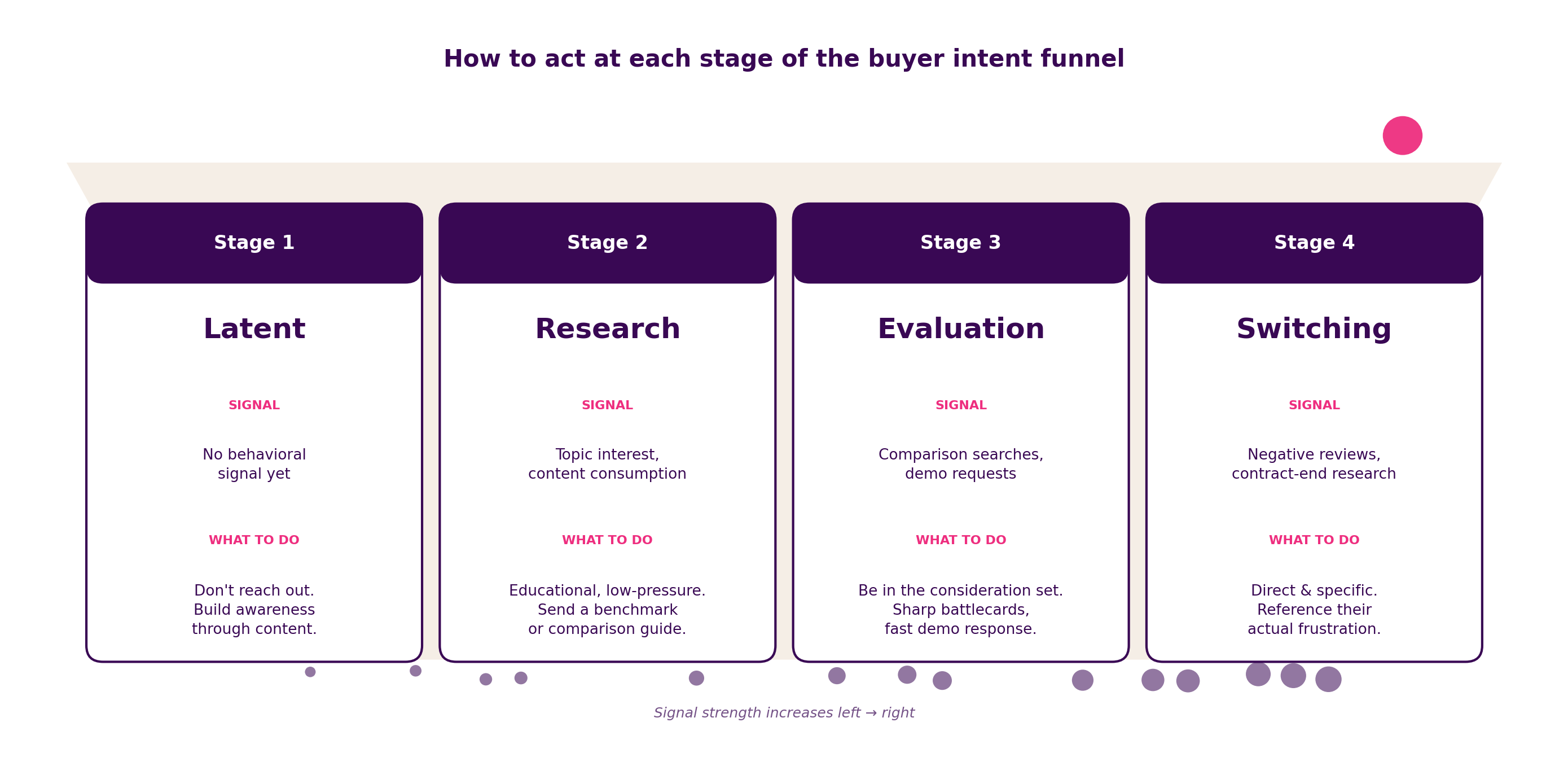
- Stage 1 (latent): Don't reach out. Build awareness through content, SEO, and category education. A cold email here is a cold email to someone who doesn't know they have a problem.
- Stage 2 (research): Educational and low-pressure. Help them research. Send a comparison guide or a benchmark report. Don't push for a demo on email one.
- Stage 3 (evaluation): Be in the consideration set. Sharp battlecards, proof points, customer references, fast demo response. They're already comparing - your job is to be on the shortlist.
- Stage 4 (switching): Direct and problem-specific. Reference the actual pain they've expressed, not a generic value prop. The reason they're going to read your email is that you understood their last six months in one sentence.
Conversion rates change with the stage too. A Stage 4 email that references the prospect's actual frustration lands very differently than a Stage 2 email about a category trend, because one is answering a question the prospect already asked out loud and the other is interrupting someone's day.
Frequently asked questions
Is the buyer intent funnel the same as the marketing funnel?
No. The marketing funnel tracks the prospect's relationship with your brand: awareness, consideration, decision. The intent funnel tracks the strength and source of their purchase signal. A prospect can be at Stage 4 intent (actively switching vendors) while at the awareness stage of your funnel - they've never heard of you. The two views complement each other; they don't replace each other.
Where does intent data fit in this model?
Most commercial intent data platforms primarily surface Stage 2 signals - topic-based content consumption tied to anonymous accounts. A few stretch into Stage 3 (comparison-page visits, demo signals). Very few cover Stage 4, which is why review-based and switching signals are usually missing from a typical intent stack.
How is this different from a sales funnel?
A sales funnel tracks deals: prospecting, qualification, demo, proposal, close. The intent funnel sits earlier - it tracks the prospect's readiness to enter your sales funnel in the first place. Match them well and your sales conversion math gets noticeably kinder.
Key takeaways
- The buyer intent funnel is not the marketing funnel. It maps signal strength, not stage of relationship.
- Four stages cover most of B2B SaaS: latent, research, evaluation, and switching.
- Stage 4 (switching/displacement) is the smallest pool with the highest conversion - and the stage most teams ignore.
- Most "intent data" surfaces Stage 2 signals, which is why generic outbound feels generic.
- Match outreach to signal stage. Stage 1 prospects don't want a cold email. Stage 4 prospects are waiting for one.
If your team is buying the same intent feeds as everyone else, the math is going to keep working out the way it always does. If you want to find the prospects who are already dissatisfied with your competitors - the Stage 4 signals nobody else is watching - start a free 30-day trial of Reechee and see what's already out there about your competitors this week.