📡 Buyer Intent What Is G2 Buyer Intent? A Practical Read on What It Catches and What It Can't Nine page-view triggers, one account-level blind spot, and the free review data most teams skim past. A practical read on both halves of G2 buyer intent.
📡 Buyer Intent Competitive Displacement: How to Win Your Competitors' Unhappy Customers Inside: the five switching signals, a five step displacement play with one artifact per step, and the stat showing 1 in 13 negative reviews name a switch.
📡 Buyer Intent How B2B Software Buyers Actually Use Reviews What 104,257 software reviews show about the few minutes a buyer actually spends on a review page, and where the useful criticism is really hiding.
⚡️ Playbooks How to Turn Competitor Reviews Into a B2B Lead Generation Channel A competitor's customer just posted exactly why they're unhappy, in public, for anyone to read. Most sales teams have no process for finding it.
🚀 New feature Introducing the Reechee MCP Server One URL turns Claude or Codex into a competitive research assistant with live data from software review platforms behind it.
📡 Buyer Intent The 5th Type of B2B Intent Data: Review-Derived Signal 31% of B2B buyers now call review platforms their top research source, up from 23% a year ago - that's where the fifth type of intent data comes from.
📚 SaaS 101 Buyer Intent Keywords: What They Are and How B2B Sales Teams Use Them Buyer intent keywords are search terms that signal where a prospect is in their buying journey - from early research to ready-to-purchase. Transactional terms convert several times better than informational ones. Here's what they are and how B2B sales teams use them.
⚡️ Playbooks How to Use Intent Data: 5 Plays That Turn Buyer Signals Into Pipeline Buying intent data is easy. Acting on it is where most teams stall. Five plays, each with its metric, for turning buyer signals into booked pipeline.
👀 Frustration-Led Growth Frustration-Led GTM: Why Competitor Pain Is the Most Underused Go-to-Market Signal A signal-hierarchy framework for B2B GTM teams: where frustration data fits next to intent topics, why it converts higher, and how to wire it in.
📚 SaaS 101 What an SDR Actually Does: Inside the Role That Builds B2B SaaS Pipeline What a sales development representative actually does, how the role differs from a BDR, the skills that matter, and the AI question - in plain English.
📚 SaaS 101 Demand Generation vs Lead Generation and Why Your SaaS Needs Both In B2B SaaS, the demand gen vs lead gen argument is mostly semantic. The strategic gap shows up in pipeline reviews. Here's the difference, and why you need both.
📚 SaaS 101 The Buyer Intent Funnel, Decoded: What Each Stage Actually Tells You A plain-English breakdown of the four buyer intent stages - and why the bottom-funnel signals nobody is watching are usually the most valuable ones.
📊 Stats & Benchmarks The State of B2B Software Buying 2026: 70+ Stats on Buyer Behavior, AI, and the Buying Committee The canonical Gartner Digital Markets buying-trends reports went homeless in early 2026. Here is the public-data 2026 successor - 70+ verified stats on how B2B software actually gets bought now, with full methodology and source links.
📚 SaaS 101 What Does GTM Stand For? (And What Go-to-Market Actually Means in B2B SaaS) Most B2B SaaS GTM strategies fail before they're written down. Here's what go-to-market actually requires - and why teams keep tripping on the same four things.
📚 SaaS 101 What Is GTM Engineering? What a GTM Engineer Does, Builds, and Earns in 2026 The four layers every GTM engineering system connects, the tools that show up in half of all job postings, and the three rungs to build in order.
📚 SaaS 101 What Is a Sales Battlecard? A Plain-English Guide for B2B SaaS Teams A sales battlecard is a one-page competitive reference reps use in live deals. Here's what goes in one, who builds it, and why stale cards kill win rates.
⚡️ Playbooks Featured Your Competitor Comparison Landing Page Is Losing Because You're Fighting the Wrong Fight 💡TL;DR: There are four distinct playbooks for a competitor comparison landing page: the Heavyweight (direct vs.), the Tactician (alternative roundup), the Mediator (referee between two rivals), and the Authority (category builder). Most SaaS teams pick one by accident, which is why their page flops. This post breaks down when
⚡️ Playbooks The Dark Funnel in B2B SaaS: Where Your Buyers Are Hiding (And How to Find Them) Your buyers complete nearly three-quarters of their journey before they ever talk to you - in private communities, peer conversations, and review sites your CRM can't track. This is the dark funnel. And your sales team's best move is showing up in those invisible spaces before
📚 SaaS 101 Intent Data vs. Contact Data: What's the Difference? Your CRM is full of contacts. Your intent vendor is full of signals. Somehow, your pipeline is still full of dead ends. That disconnect usually starts with a confusion most B2B sales teams carry around without realizing it: treating intent data and contact data as interchangeable. They solve different problems.
⚡️ Playbooks How to Build a Sales Battlecard That Actually Wins Competitive Deals 💡TL;DR: Sales battlecards lose deals not because of bad formatting, but because the intel inside them is stale or built on internal assumptions. This guide covers what a winning battlecard contains, where to source competitive intelligence that's reliable and specific, and how to keep cards current enough
📡 Buyer Intent What Is B2B Intent Data? The 5 Types of Buyer Intent Data, Compared A side-by-side table of the five buyer intent data types, the three that never get past the account, and a plain call on which ones a sales team should pay for.
📚 SaaS 101 Buying Signals in Sales: How to Spot and Act on the Ones That Close Deals 💡TL;DR: Buying signals are behaviors or events that indicate a prospect is moving toward a purchase. Most sales teams track generic intent data but miss the highest-value signals: negative competitor reviews, trigger events, and stacked signals from multiple sources. Speed and specificity matter more than volume - the first
📚 SaaS 101 User Persona vs Buyer Persona in SaaS: Why the Difference Matters TL;DR: In B2B SaaS, the person who buys your product and the person who uses it every day are often two completely different people. A buyer persona describes who signs the contract; a user persona describes who logs in every morning. Mixing them up costs you deals, adoption, and
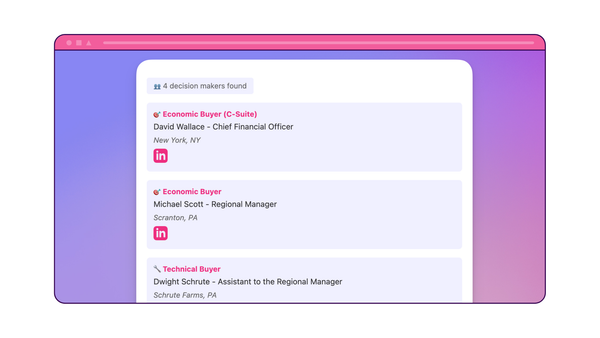
🚀 New feature Featured Finding a Frustrated User Is Only Half the Battle. Here's the Other Half. You finally found them. Someone at a mid-market tech company just left a scathing review about your competitor. They're frustrated with clunky workflows, missing integrations, and terrible support response times. Your product solves all of this. Perfect opportunity, right? There's just one problem. The reviewer
⚡️ Playbooks Multithreading Sales: The Complete Guide to Engaging B2B Buying Committees Single-threading puts a gun to your pipeline's head. One point of failure. Zero room for error. When your champion leaves, gets reassigned, or loses a budget fight, your deal evaporates - and your forecast implodes. Single-threaded deals rarely survive. Win rates climb sharply once several stakeholders are