
Competitive Displacement: How to Win Your Competitors' Unhappy Customers
Inside: the five switching signals, a five step displacement play with one artifact per step, and the stat showing 1 in 13 negative reviews name a switch.

Every account worth winning in your category is already paying somebody. Usually a competitor, sometimes a spreadsheet, but the era of empty territory is over in most B2B SaaS markets.
What is competitive displacement in B2B sales?
Competitive displacement is a sales motion that targets accounts currently paying for a competitor's product and converts their dissatisfaction into a switch. It's different from net-new selling in one structural way: the buyer already has a solution, a contract, and switching costs, so the deal only happens when their frustration outweighs the pain of moving.
Everything that follows hangs on that last clause. Nobody rips out a tool they merely dislike. Gartner's 2023 survey of technology buyers found that 60% of buyers involved in renewal decisions regret nearly every purchase they make - and yet most of them renew anyway, because regret alone doesn't clear the switching-cost bar. Displacement selling is the craft of finding the accounts where it does.
It's also not the same thing as comparison-page SEO or "alternative to X" ads. Those are useful capture surfaces for buyers who already decided to look. Displacement as a sales motion starts earlier: it identifies the frustrated customer before they start shopping, then earns the first conversation.
Why displacement beats net-new pipeline right now
In a mature category, displacement isn't a side tactic. It's the only honest description of where revenue comes from. If your market has five or more established vendors, the qualified buyer who owns no tool at all is close to extinct. What looks like net-new demand is mostly someone quietly unhappy with an incumbent.
The math favors the switcher hunt too. A displaced account arrives with a budget line that already exists, a problem definition they've refined through pain, and a clear benchmark for what "better" means. Compare that with net-new deals, where you fund the education phase yourself. Gartner's 2022 research found 56% of organizations reported high regret over their largest recent tech purchase - each one of those is a budget line attached to an unhappy owner.
And the buyer got there without you: two-thirds of software buyers prefer to engage sales only after doing their own research, per G2's 2025 Buyer Behavior Report. If you wait for the inbound hand-raise, you're meeting a buyer whose shortlist is already built. Displacement is how you get into the story before the shortlist exists.
| Net-new deal | Displacement deal | |
|---|---|---|
| Education phase | You fund it | Buyer already did it |
| Budget line | Must be created | Already exists |
| Benchmark for "better" | Vague | The incumbent, precisely |
| Competition at first touch | Every vendor in the category | Whoever heard the signal first |
The timing problem: most displacement campaigns fire blind
The standard competitive displacement strategy is an always-on marketing campaign: build the comparison page, run ads at the competitor's audience, arm reps with a battlecard, wait. It's not wrong. It's just aimed at a random moment in someone else's contract.
Think about what that audience looks like on any given day. A competitor's customer base is mostly fine - onboarded, invested, renewed. Blanket that audience with "switch to us" messaging and you're paying to reach the large majority who aren't movable, while the few who are get the same generic message as everyone else. That's why displacement campaigns measured on impressions look busy and convert poorly.
An account becomes displaceable at specific, observable moments: when frustration gets articulated in public, when the champion who bought the tool leaves, and when the renewal window opens. Outside those windows, the best pitch in the world bounces off a signed contract. Inside them, even a modest pitch gets a meeting, because you're answering a question the buyer is already asking themselves. Timing doesn't just improve the play. It is the play.
How do you know when a competitor's customer is ready to switch?
A displaceable account almost always announces itself before it opens an evaluation - in reviews, community threads, and renewal behavior. The signal is articulated frustration: a real person at the account describing a real gap, in public, in their own words. Catch that, and you've found a buyer months before your competitors' sales teams know the account is in play.
The signals, roughly in order of strength:
Negative reviews. A two-star review on G2 or Capterra is frustration with a name, a date, a role, and a reason attached. It's the only switching signal where the buyer writes the discovery call notes for you - and buyers lean on these reviews far more than vendors assume. We ran the numbers across the review corpus Reechee monitors (August 2026): roughly 1 in 13 negative reviews (rating of 2 stars or less) explicitly mentions switching or an alternative in the review text itself - 571 of 7,419 - and that's just the ones who say it outright.
Community complaints. Feature-gap threads on Reddit, "anyone else struggling with..." posts in Slack communities. Less structured than reviews, but earlier - people vent before they review. This is the same review-signal territory most teams never mine because it doesn't arrive as a form fill.
Pricing-change backlash. When a competitor repackages plans or raises prices, a cohort of their customers starts doing switching math simultaneously. Public backlash threads tell you exactly who.
Champion departure. The person who bought the tool defends the tool. When they leave, the contract loses its sponsor, and their successor inherits software they didn't choose.
Renewal windows. The weakest signal on its own, but it multiplies the others. Frustration voiced three months before renewal is a live deal. The same complaint mid-contract is a note for next quarter.
These are buying signals - and review-based signals are a different class of intent data from the anonymous topic-surge scores most teams buy, because the frustration is attributable to a specific account and a specific problem. Monitoring them manually across platforms is the tedious part; this is the job review-monitoring tools like Reechee's Watchlist exist to do, turning new negative reviews of the products you compete with into alerts with the reviewer's context attached.
How do you run a displacement play?
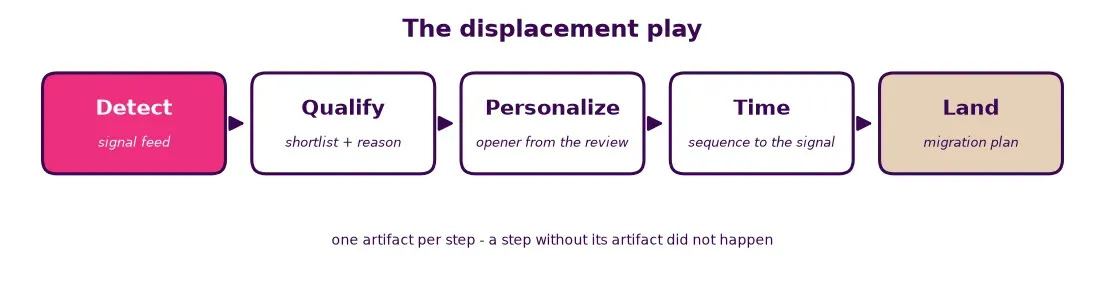
The play is five steps: detect, qualify, personalize, time, land. Each has one artifact, and none of them involves bashing the competitor.
- Detect. Stand up monitoring on your top 3-5 competitors' review streams and communities. The artifact is a signal feed - every new negative review or complaint, with source, date, and author role.
- Qualify. Not every frustrated reviewer is your buyer. Score the account against your ICP and the complaint against your actual strengths. If they're angry about a gap you share, pass. The artifact is a shortlist with a reason attached to each name.
- Personalize. Open with their frustration, not your pitch. Quote the substance of what was said publicly ("saw the feedback about X breaking at scale...") and connect it to the one thing you do differently. Your battlecard supplies the proof points; the review supplies the opener.
- Time. Sequence outreach to the signal, not to your quota calendar. A review posted this week deserves outreach this week. If you can find the renewal month, plan the heavier touches around it.
- Land. Sell the migration, not just the product. Switching costs are what kill displacement deals, so the close is a migration plan: data, timeline, who does what, and what the first 90 days look like. G2's 2024 Buyer Behavior Report found buyers prefer to renew what they have rather than switch. The migration plan is what dismantles that default.
One rule across all five: never trash the incumbent. The buyer chose that tool, defended that choice internally, and will hear an attack on the product as an attack on their judgment. Agree the frustration is legitimate, then show the different road.
Measuring a displacement motion
Displacement gets measured on attributed pipeline, not campaign activity. Three numbers do most of the work:
Displacement win rate: closed-won against a named incumbent, divided by qualified displacement opportunities. Track it per competitor - it tells you where your story actually lands.
Competitive pipeline share: what fraction of new pipeline has a named incumbent attached. If it's under a third in a crowded category, your team is either missing signals or logging them badly.
Signal-to-touch time: days between the frustration signal appearing and your first personalized touch. Watch this one hardest. The signal decays: a reviewer frustrated in March has picked a shortlist by June. And G2's 2025 Buyer Behavior Report describes shortlists shrinking year over year; arrive after one forms and you're not in the deal at all.
Be honest about denominators. A focused displacement motion produces tens of opportunities a quarter, not thousands, so judge it quarterly and resist the urge to A/B-test your way to significance on twelve data points.
Frequently asked questions
What is an example of competitive displacement?
A CRM vendor monitors reviews of a rival, spots a mid-market customer's two-star review complaining about reporting limits, and reaches out referencing that exact gap with a migration plan and a reporting demo. Ninety days later the account switches at renewal. That timed, signal-driven sequence is displacement.
Is competitive displacement ethical?
Yes, when it serves a buyer's articulated need. The customer publicly stated a problem; offering a solution to that problem is what sales is for. The line: work from what buyers actually said, be honest about your own tradeoffs, and never misrepresent the competitor.
How long does a displacement deal take?
Longer than the frustration, shorter than a cold enterprise cycle. The constraint is usually the incumbent's renewal date, so expect one to three quarters between first signal and signature - which is why detecting frustration early matters more than pitching hard late.
Where to start
Three moves, in order. First, pick your top three competitors and read their last 50 negative reviews - you'll know your real displacement story by the end of the afternoon. Second, stand up monitoring so new frustration reaches you the week it's posted, whether that's manual review sweeps or an alerting tool. Third, build the migration plan before you need it, because it's the artifact that closes these deals. The accounts are already frustrated. Start with the 50 reviews this afternoon.