
How B2B Software Buyers Actually Use Reviews
What 104,257 software reviews show about the few minutes a buyer actually spends on a review page, and where the useful criticism is really hiding.


Most software vendors treat their G2 page like a storefront. Buyers treat it like a background check.
There is a comfortable story about review sites: a buyer has a problem, searches a category, discovers three vendors, reads what real users say, and picks the best one. Vendors plan their review strategy around that story.
The evidence says something less flattering and more useful. Buyers arrive at reviews late, with a favourite already in mind, looking for a reason to be worried. Understanding what they do in those few minutes changes what you put on the page and what you do with everybody else's page.
The shortlist is set before anyone reads a review
The shortlist forms early and barely moves. 6sense's 2025 B2B Buyer Experience Report found that buyers fill 3.4 shortlist spots on day one of the journey, and that 95% of the time the eventual winner was already on that day-one list. The vendor ranked first when the shortlist formed wins roughly 80% of the time.
TrustRadius's 2026 B2B Buying Disconnect points the same way from a different angle: 79% of buyers had already heard of the product they bought before research started, 83% shortlisted three or fewer products, and 67% ended up buying their first choice.
So when 74% of technology buyers say they used reviews to inform the decision, that word "inform" is carrying weight. They are not browsing a category. They are checking a decision they have mostly made, and the question in their head is closer to what am I about to regret than who else should I consider.
That reframes the whole page. A review page is a due-diligence surface. It gets read by someone looking for the reason to slow down, and by the two or three other people on the buying committee who were not in the room when the favourite got picked. For the wider shift in where buying journeys start, our state of B2B software buying page holds the current numbers.
The star rating stopped separating anything
Ask a buyer what matters on a review page and the rating comes up first. 61% call the average user rating "very important", and most set a 4.0 floor before a product gets considered at all.
Now look at what that floor actually excludes. We queried our own review corpus on 22 July 2026 - 104,257 reviews across five platforms, published between January 2009 and July 2026:
| Platform | Reviews | Average rating | Share rated 4.0 or higher |
|---|---|---|---|
| TrustRadius | 33,865 | 4.39 | 86.5% |
| Capterra | 30,693 | 4.50 | 90.8% |
| G2 | 28,076 | 4.48 | 88.7% |
| SourceForge | 1,169 | 4.65 | 96.5% |
| Trustpilot | 10,454 | 3.21 | 54.3% |
On the four platforms built for software evaluation, nine reviews in ten clear the bar buyers say they set. A 4.0 minimum removes almost nothing. Two products at 4.4 and 4.6 are not meaningfully different, and buyers know it - which is why the rating works as a gate rather than a comparison.
Trustpilot is the instructive exception, and it is worth saying why rather than averaging it in. It sits at 3.21 because it is not really a software evaluation platform: reviews there are collected at the vendor domain level, from a much broader population that includes end consumers and support-ticket escalations. That is a different reviewer writing for a different reason, so any analysis that pools it with G2 is measuring two things at once.
If your differentiation strategy is climbing from 4.4 to 4.6, you are competing on the one dimension the buyer has already discounted. Comparison pages run into the same wall.
So they read the cons box
With the rating exhausted as a signal, attention moves to text. TrustRadius asked buyers what they actually go to a review site for and found review content and qualitative feedback at 18%, reviewer relatability at 17% - with product scores and award badges ranking below both. In a separate analysis of how reviews shape vendor conversations, TrustRadius found the most influential content is the cons buyers mention and the use cases described by reviewers who gave low ratings.
Buyers hunt for the complaint.
Across the structured platforms, a cons field is filled in on 96.7% (G2), 98.1% (Capterra) and 98.3% (TrustRadius) of reviews. Almost every review contains a criticism, including the glowing ones. Look at the five-star reviews specifically:
| Platform | Five-star reviews | Share carrying a classified pain point |
|---|---|---|
| G2 | 13,348 | 42.1% |
| Capterra | 20,227 | 44.7% |
| TrustRadius | 13,750 | 49.5% |
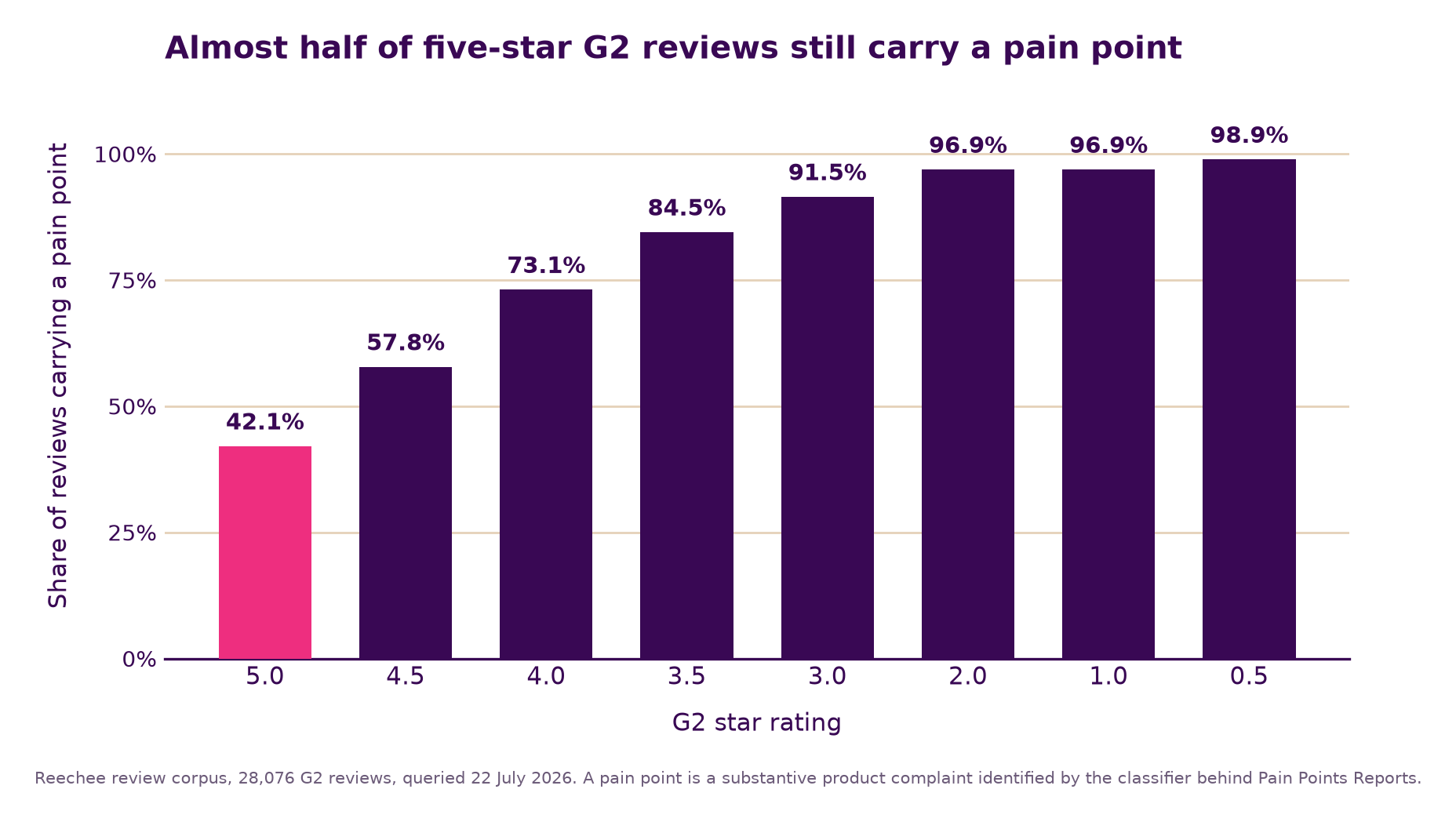
Somewhere between four and five out of every ten perfect-score reviews contain a real, articulated problem. So a buyer who filters to one-star reviews to find the dirt is looking in the smallest and least representative pile. The useful material is sitting inside the recommendations, written by people who like the product enough to rate it five stars and still had something they needed to say.
The pattern is continuous rather than binary. On G2, the share of reviews carrying a pain point climbs from 42.1% at five stars to 57.8% at 4.5, 73.1% at 4.0, 91.5% at 3.0 and 98.9% at half a star. The cons text lengthens along the same curve: 182 characters at five stars, 257 at three, 437 at one, 643 at half a star. Frustration shows up in the word count before it shows up in the score.
One more detail that matters for anyone writing review-generation copy: on the structured platforms, the average filled-in cons field runs 174 to 210 characters. That is roughly 25 to 35 words. The "detailed feedback" buyers say they want arrives as two sentences, usually naming one specific thing. Reviewers are not writing essays, and a buyer scanning for risk is reading maybe a dozen of these fragments.
"Someone like me" only works on some platforms
Reviewer relatability - same industry, same company size, same role - scores nearly as high as the review text itself. It is doing a specific job. When 73% of technology buyers believe they regularly or sometimes encounter fake reviews, "this person has my job title at a company my size" becomes the cheapest available authenticity check.
Whether a buyer can run that check depends entirely on what the platform bothered to collect:
| Platform | Reviews with a reviewer job title | Reviews with company size |
|---|---|---|
| G2 | 99.1% | 85.9% |
| Capterra | 98.9% | 96.4% |
| TrustRadius | 50.4% | 100% |
| Trustpilot | 1.5% | 1.4% |
Filtering to your own segment is a real behaviour on G2 and Capterra and mostly impossible elsewhere. Half of TrustRadius reviews carry no job title at all, so a buyer trying to find a peer there is working from company size and the text alone.
If you are trying to influence how your product reads to a mid-market operations buyer, the reviews doing that work are the ones from mid-market operations people, and you can see which segments you are thin in. If you are researching a market, the platform determines what questions you can even ask of it - a point we get into in the practical guide to buyer intent data.
Recency beats volume, and the number nobody has
Old reviews stop counting quickly. G2's benchmark report with Heinz Marketing found 65.7% of buyers rate reviews from the last three months as very valuable, dropping to 45.3% at three to six months, 21% at six to twelve, and 11.2% past a year. The survey was fielded by OnTarget Consulting & Research in late September 2017, with 548 respondents. That study is from 2018, and we cite the date deliberately: it remains the best hard number available on B2B review recency, and no current primary research has replaced it. Treat the shape of the curve as reliable and the exact percentages as eight years old.
Which leads to something worth saying plainly on a page about buyer behaviour: nobody currently publishes how many reviews a B2B software buyer actually reads.
Plenty of numbers circulate. "Buyers read up to ten reviews" gets attributed to G2 and does not appear in any G2 report we could locate. "95% of buyers read reviews before engaging a vendor" travels without a source. The often-quoted figure about products with five reviews being 270% more likely to be purchased comes from Northwestern's Spiegel Research Center and is consumer e-commerce research, not B2B.
What vendors do publish is how many reviews buyers want to see on a page before it feels credible. That is a supply-side threshold, not a measure of consumption. The honest position is that review reading is one of the least measured moments in the B2B purchase, which is a strange gap given how much money moves through it.
What this means if you sell software
Your own page should be built for the audit. Your reviews are not winning you consideration, because the day-one shortlist already settled that. What they decide is whether a buyer who likes you finds a reason to hesitate, and whether the skeptic on the buying committee finds ammunition. That argues for recency over volume, and for coverage across the segments you actually sell to. It also means a wall of five-star reviews with empty cons fields reads as less trustworthy rather than more. The mechanics of getting more of the right reviews are their own subject, and we covered them in why some SaaS companies get more reviews.
Everybody else's page is a different opportunity. Forty-odd percent of your competitors' five-star reviews contain a named, dated, first-person account of something their product does not do well, written by a customer who is still happy enough to recommend them. That is about the earliest legible form of a switching signal you can get, well before the renewal conversation and long before any intent score notices anything. It is the premise behind Frustration-Led Growth, and the reason we treat review text as a distinct type of intent data rather than a marketing asset.
Reading a few hundred competitor reviews by hand is a reasonable afternoon. Reading them continuously across a category is not, which is where a tool helps: Reechee monitors competitor products across the review platforms and raises an Opportunity Alert when a reviewer describes a pain point that matches what you sell against, with the reviewer's company and Buying Committee attached. One way to act on the finding, not the only one. If you would rather start by hand, pick your three closest competitors, sort their reviews by most recent, and read only the cons fields - that alone will tell you more than most buying signal dashboards, and it doubles as a churn-prevention exercise on your own product.
Start monitoring for free - Reechee includes a 30-day free trial on Starter and Scale.
Methodology
First-party figures come from Reechee's review database, queried on 22 July 2026. The corpus held 104,257 reviews across G2 (28,076), Capterra (30,693), TrustRadius (33,865), Trustpilot (10,454) and SourceForge (1,169), with publication dates from 30 January 2009 to 22 July 2026.
"Carries a classified pain point" means the review was labelled as containing a substantive product complaint by the classifier that powers our Pain Points Reports, not merely that the cons field was non-empty. Cons length is the character count of the cons field where one was filled in.
Two limits worth stating. The corpus covers products that Reechee customers track, so it over-represents competitive B2B SaaS categories and is not a random sample of the software market. And platform structure differs enough that pooling them produces nonsense - Trustpilot has no pros/cons fields and collects reviews at the vendor domain level, so it is reported separately throughout rather than averaged in.
External figures are linked inline to their primary source. Where a widely circulated statistic could not be traced to a primary publication, we left it out and said so.