
The 5th Type of B2B Intent Data: Review-Derived Signal
31% of B2B buyers now call review platforms their top research source, up from 23% a year ago - that's where the fifth type of intent data comes from.


First-party. Second-party. Third-party. Every article about B2B intent data teaches the same three-way split. None of them ask whether the signal underneath is actually any good.
What are the types of B2B intent data?
B2B intent data is conventionally split into three types based on who collects it: first-party (your own data), second-party (a partner's data shared with you), and third-party (aggregated data purchased from providers). The taxonomy describes the relationship, not the kind of evidence each type actually contains.
First-party is whatever your own website, product, and CRM capture directly - page visits, feature usage, form fills. It's the most accurate data you'll have, because you watched it happen. It's also the smallest: you only see people already inside your orbit, distinct from the contact data sitting in the same systems, which tells you who exists, not when they're moving.
Second-party is another company's first-party data, shared with you through a partnership, most often through a subscription. Review platforms are the biggest source here - when you pay for access to review-site activity data, you're buying second-party intent.
Third-party is the broadest and thinnest: data aggregated across the web through tracking pixels and data co-ops, then sold to anyone who'll pay. Platforms like Bombora and 6sense aggregate this kind of web activity to flag that "an account is researching CRM software," without saying who at the account or why.
None of these three categories says anything about whether the underlying signal is a guess or a fact.
Did Gartner's intent data prediction come true?
Gartner predicted in 2021 that more than 70% of B2B marketers would use third-party intent data by 2022. On adoption, that came true. But a December 2025 survey of 750 marketing leaders found 87% call their intent signals unreliable, and only 26% convert to qualified opportunities. The prediction won on volume, lost on trust.
Gartner's original language, from a 2021 report: by the end of 2022, more than 70% of B2B marketers would be using third-party intent data to target prospects or engage buying groups. Every "types of intent data" article published since has repeated some version of that number.
The adoption side held up. Third-party intent tools are a standard line in most B2B martech stacks now, and nobody's shopping around asking whether they need one - just which one. (For the fuller 2026 picture of how B2B software actually gets bought, we've put together a broader stats roundup.)
The trust side didn't hold up. DemandScience surveyed 750 senior B2B marketing leaders in December 2025 and found 87% of organizations say their marketing investments produce unreliable or inflated intent signals - clicks, downloads, behavioral scores that look like buying intent but don't hold up. Only 26% of those signals convert into qualified opportunities. Two-thirds of the leaders surveyed said their campaign metrics look successful on a dashboard and still fail to produce revenue.
A better vendor doesn't fix this. Third-party intent data scaled past what its underlying evidence could support - and the mechanism that made it possible in the first place was already wobbling.
What happened to cookie deprecation?
No - Google reversed its plan to force third-party cookie deprecation in Chrome in July 2024, moving to a user-choice model instead. Safari and Firefox already block cross-site tracking by default, so the addressable surface for third-party intent data keeps shrinking anyway, just without a single cutoff date to plan around.
Third-party intent data runs on tracking - cookies, pixels, and the cross-site behavior they capture. For years, the plan was straightforward: Chrome would phase out third-party cookies the way Safari and Firefox already had, and every third-party intent vendor would need a new data source or a new business.
Then, in July 2024, Google reversed course. Instead of forcing the phase-out, Chrome added a user-choice setting and kept its Privacy Sandbox APIs running in parallel. The apocalypse got postponed.
Postponed isn't cancelled, though. Safari and Firefox still block cross-site tracking by default, and a growing share of Chrome users opt out where they're given the choice. The pool of trackable behavior third-party intent depends on keeps shrinking - just gradually, without the single deadline that would have forced every vendor to adapt at once.
Gradual decline plus a trust collapse is a worse combination than a hard deadline would have been. A deadline forces a decision. This just keeps eroding the floor under a category that was already struggling to prove it works.
Why "second-party" doesn't quite cover review data either
Second-party data is supposed to be the good stuff - a direct relationship instead of an anonymous aggregator. Relative to third-party, it is: you get the platform, the timing, sometimes the account. But look closely at what's actually being sold, and most review-platform intent products track the same kind of thing third-party data does. Page views. Comparison clicks. Which category page someone browsed, and for how long.
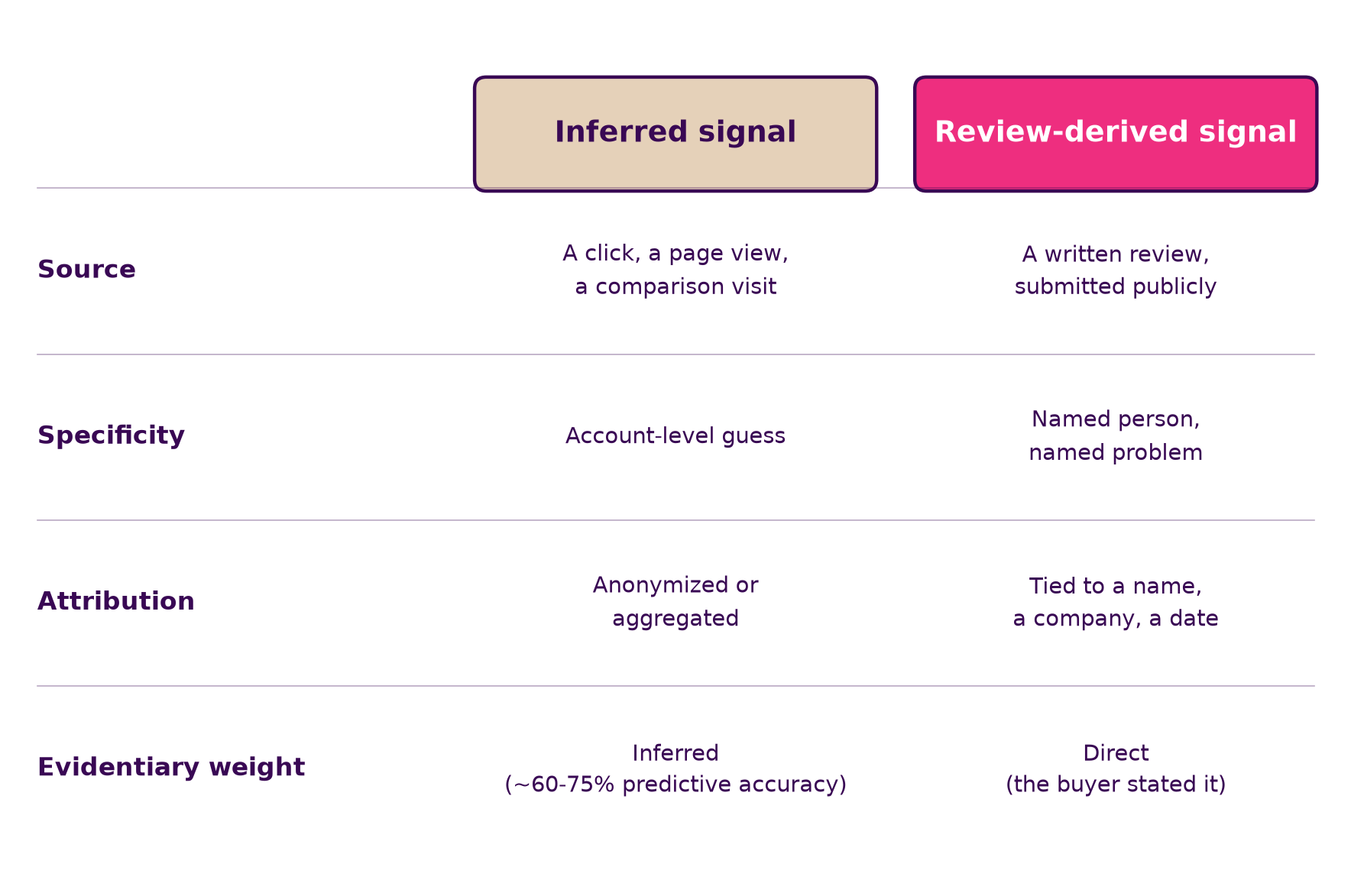
That's still inference, and inference has a ceiling. Even well-implemented intent data models cap out around 60-75% predictive accuracy - meaningfully better than a guess, nowhere close to certainty. "An account viewed a comparison page" tells you someone might be shopping. It doesn't tell you what they think, what they're frustrated with, or whether they're going to buy anything at all.
TrustRadius comes closest to naming the gap, calling review-platform data "downstream intent data" and describing it as the next best thing after a brand's own first-party data. That's progress - but it's still filed as a flavor of second-party, defined by who's sharing the data rather than what the data actually is.
The real dividing line separates something a buyer did from something a buyer said. Who collected the signal matters less than what kind of signal it is.
What is review-derived signal?
Review-derived signal is a written, publicly attributed, substantive statement from a buyer describing a specific product experience - a complaint or a piece of praise, tied to a name, a company, and a date. Unlike inferred behavioral signals - a page view, a "researching" flag - it doesn't require guessing at intent. The buyer already said what they think, in their own words.
Call it review-derived signal, or testimonial intent data if that travels better outside this taxonomy conversation. Either way, it passes a specific three-part test that most intent data doesn't:
- Public. It exists outside any one company's walls, visible to anyone doing the same research.
- Attributed. It's tied to a specific person, company, and date - not an anonymized account ID.
- Substantive. It describes something concrete: a specific feature gap, a specific integration failure, a specific reason someone renewed. Not just a visit.
The contrast is easy to feel side by side. "An account in the logistics sector viewed a competitor's comparison page yesterday" is a real signal, but it's thin - you're inferring intent from an action. "A logistics operations manager at a 200-person company wrote, three days ago, that her team lost half a day a week reconciling data between two systems that don't talk to each other" is a different kind of evidence entirely. Nobody had to guess what she meant. She said it.
Reviews have become the #1 information source for 31% of B2B buyers, up from 23% just a year earlier - buyers are spending more of their research time writing and reading exactly this kind of testimony. The supply of review-derived signal is growing at the same moment third-party data's credibility is shrinking.
Reechee's own guide to buyer intent data already flagged review-based intent as underrated within second-party data. The next step is admitting second-party was never really the right box for it.
How this changes what you track
Volume was always third-party data's argument: broad coverage, cheap per-account cost, easy to bolt onto an existing stack. Review-derived signal doesn't compete on volume - a frustrated review is rarer than a page view by orders of magnitude. What it offers instead is strength: fewer signals, each one worth more.
Practically, that means treating review text as its own tracked source, not a line item inside a second-party feed. A page-view alert and a written complaint shouldn't route to the same queue at the same priority - they're not the same quality of evidence, and acting on intent signals well means treating them differently from the start.
This is close to the idea behind Frustration-Led Growth: using a buyer's stated frustration, not an inferred signal, as the entry point for a conversation, and treating competitor pain as a go-to-market signal worth building a motion around, not just a data point to note. It's one way to act on the distinction this piece is making, not the only one. Reechee runs this against a database of roughly 84,000 analyzed B2B software reviews, and the pattern holds at scale: written complaints are rarer than page views, and worth more per signal.
Most of this activity happens before anyone on a vendor's team knows the account exists - deep in what's become known as the dark funnel. Review-derived signal is one of the few ways to see into it without waiting for a form fill.
If you're building or buying a 2026 signal stack, sort what you're already tracking into two piles: inferred and directly stated. The stated pile is smaller. It's worth more than its size suggests.
Key takeaways
- The 1st/2nd/3rd-party taxonomy sorts by relationship, not evidence type. It can hide the difference between an inferred action and a direct, written statement - check which one you're actually looking at before trusting a label.
- Third-party intent data won on adoption, lost on trust. 87% of organizations call their intent signals unreliable or inflated as of December 2025.
- Cookie deprecation stalled - it didn't disappear. Plan for gradual erosion of third-party reach, not a single policy cutoff.
- Review-derived signal passes a specific test: public, attributed, substantive. Most "second-party" review data sold today is still behavioral, not textual - confirm which one you're actually paying for.
- Next step: pull your current signal stack and sort each source into "inferred" or "directly stated." Give the stated pile its own workflow this quarter, instead of leaving it buried inside a second-party line item.
Ready to see what review-derived signal looks like in your own category? See how Reechee works - 30-day free trial included.