
The State of B2B Software Buying 2026: 70+ Stats on Buyer Behavior, AI, and the Buying Committee
The canonical Gartner Digital Markets buying-trends reports went homeless in early 2026. Here is the public-data 2026 successor - 70+ verified stats on how B2B software actually gets bought now, with full methodology and source links.

The Gartner Digital Markets reports that anchored every "state of B2B software buying" article since 2022 stopped publishing this year. In January 2026, G2 acquired Capterra, Software Advice, and GetApp from Gartner; the deal closed in February, and Gartner's 10-K disclosed approximately $110 million in consideration. The canonical 2023, 2024, and 2025 software-buying-trends surveys went with the property. Meanwhile, the way B2B software actually gets bought has changed more in twelve months than it had in the prior five - half of buyers now start their research in an AI chatbot, the average buying decision pulls in a 22-person network, and the typical buyer arrives at the first sales call with the decision largely made.
B2B software buying is now AI-mediated. 51% of buyers start their research in an AI chatbot, not a search engine (G2, 2026). Among mid-market SaaS CMOs, 84% use LLMs for vendor discovery (Wynter, 2026). The buying committee is bigger and more networked. Forrester puts the typical decision at 22 stakeholders (13 internal + 9 external influencers); 6sense puts the average buying group at 10.1 people; the gap is methodology, not contradiction (Forrester, 2026 / 6sense, 2025). Buyers arrive informed. 80%+ of buyers have already chosen a preferred vendor before first sales contact; 95% of purchases come from the Day-One shortlist (6sense, 2025). Trials replaced demos as the risk-reduction tool. 60%+ of buyers now use trials; 78% on $10M+ deals (Forrester, 2026).
Why this report exists
Anyone who has cited "according to Gartner" in a software-buying article over the past five years has probably linked to a specific URL on gartner.com/en/digital-markets/insights/. That URL no longer works.
In late January 2026, G2 announced the acquisition of Capterra, Software Advice, and GetApp from Gartner. The sale closed February 5, 2026, and Gartner's 10-K filing on February 12 disclosed approximately $110 million in consideration before customary purchase-price adjustments. The combined network now reaches more than 200 million annual buyers and houses roughly 6 million verified customer reviews.
The headline of that deal is the press release. The footnote is the data vacuum. The 2023, 2024, and 2025 Global Software Buying Trends reports - the most-cited public B2B software-buying surveys of the past three years - are no longer being maintained or republished. G2 redirects every /digital-markets/insights/* URL to a generic root rather than reposting the underlying research. The carryover stats still appearing in industry articles point to dead pages or, at best, to Wayback snapshots.
G2's stated framing for the acquisition is direct: "the definitive system of record for B2B software in the age of AI." That language matters because it foregrounds the post's other major theme - the AI search shift - and helps anchor it in the news rather than in trend forecasting.
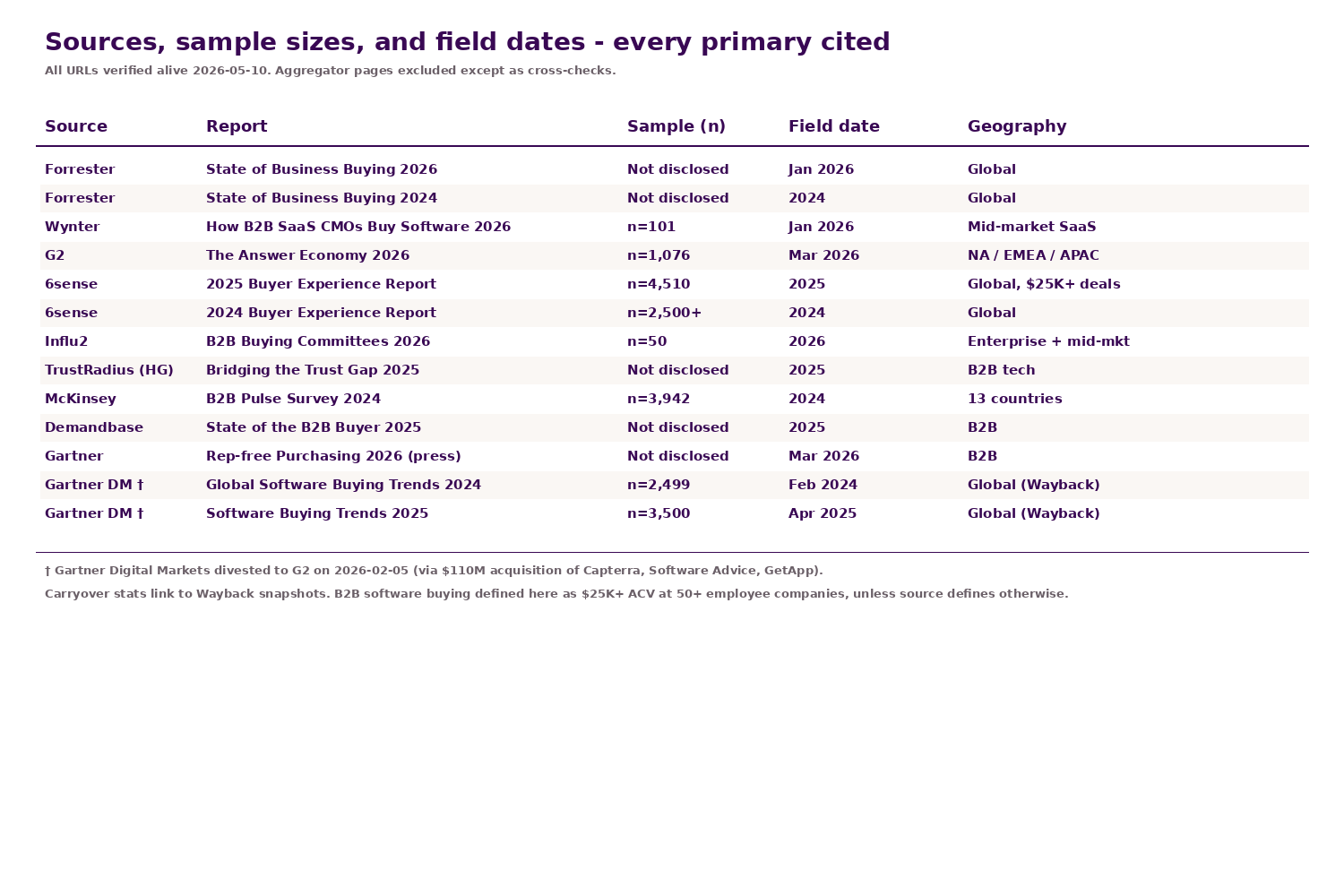
This report is the public-data 2026 successor. It synthesizes the available primary sources - Forrester, Wynter, G2, 6sense, Influ2, TrustRadius (an HG Insights company), and McKinsey - into a single citable reference for how B2B software gets bought now. Carryover Gartner Digital Markets stats that remain in active citation link to Wayback snapshots, with the divestiture noted alongside.
Methodology and how to read this page
Every cited stat in this report comes from a publicly available primary source published between January 2024 and April 2026. Primary sources are linked directly, in the sentence where the claim appears. Aggregator pages are excluded except where they cross-check a number that has already been linked to its primary.
The inventory does not include proprietary data slices, anonymized customer numbers, or any non-public dataset. Where a number originates with a specific named survey, that survey's name, sample size, geography, and field date appear in the body text - not just in the footnote.
When sources disagree, the disagreement is methodological, not contradictory. The clearest example is buying-committee size: Forrester's 22, 6sense's 10.1, and Influ2's distribution of 2-4 are three different counts of three different things. Each section that surfaces a disagreement explains the methodology behind each number. The disagreement itself is signal, not noise; it is also the most-cited part of any "state of buying" reference page when AI tools answer "how big is a B2B buying committee."
Carryover stats from the now-divested Gartner Digital Markets property are still cited where they remain canonical. Two changes apply: each carryover stat links to the Wayback snapshot of its source page (the live URL is dead), and each is footnoted as "as of last published [date]; survey property divested February 5, 2026."
For purposes of this report, "B2B software buying" means software purchases of $25,000 ACV or more at companies with 50 or more employees. That excludes self-serve SaaS subscriptions under that threshold and consumer software entirely. Where a primary source defines its sample differently, the report uses the source's definition and notes it in the body.
The most-recent-source rule applies throughout. Where 2026 data exists from one primary source and 2025 data from another, the 2026 number sits in the body and the 2025 number lives in the footnote for trend visibility.
Where the buying journey starts in 2026 - and why "search" stopped meaning Google
The starting point of B2B software research moved off Google. G2's The Answer Economy report (March 2026, n=1,076) found that 51% of B2B software buyers now begin their purchasing process in an AI chatbot rather than a traditional search engine. Seventy-one percent rely on chatbots for software research, up from 60% in 2025. Fifty-three percent find AI research more productive than traditional search, up from 36%. Only 3% of buyers report that AI chatbots haven't meaningfully changed their research habits.
Where research starts is the smaller story. The bigger one is what AI changes about which vendors get considered at all. Sixty-nine percent of buyers chose a different software vendor than they had initially planned, based on AI chatbot guidance. One-third purchased from a vendor they had never heard of before the AI surfaced it. Eighty-five percent rate vendors more highly when an AI tool cites them in its answer.
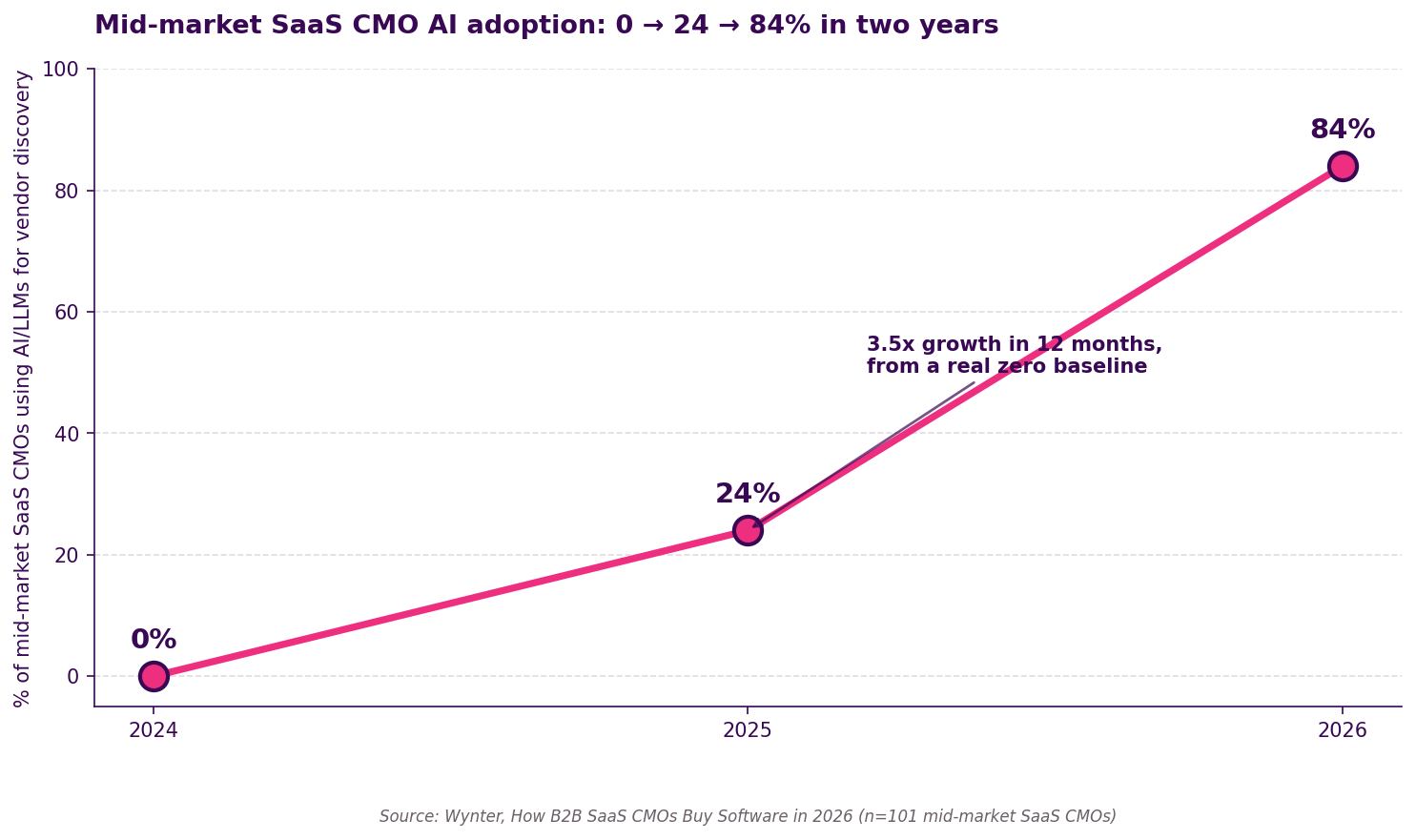
Among mid-market SaaS CMOs, the curve is steeper. Wynter's January 2026 survey of 101 mid-market SaaS CMOs found 84% now use AI/LLMs for vendor discovery and 68% start their research in AI tools before traditional search. The growth rate from 2024 to 2026 was a real zero baseline to 24% to 84% - 3.5x year-over-year for two consecutive years. The sample is small and CMO-specific; the trajectory is the quotable part, not the absolute number.
What hasn't moved is the role of peer signals. Wynter found that 65% of CMOs start vendor searches in peer communities, 42% rank word of mouth as their top influence, and only 2% rank cold outreach as their top influence - the lowest of any channel measured. AI sits next to peer-driven discovery, not on top of it.
The middle of the journey is not exempt either. 6sense's 2025 Buyer Experience Report found AI features in 89% of B2B purchases. AI tools show up not just at the start but throughout - validating shortlists, summarizing reviews, drafting evaluation questions. Buyers are running head-to-head comparisons inside Deep Research and Thinking-mode prompts, not just early discovery.
The buying committee got bigger and smaller - depending on who is counting
Four numbers are in active circulation for "average B2B buying committee size." None of them is wrong. They count different things.
Forrester's State of Business Buying 2026 (January 21, 2026) places the typical decision at 22 people: 13 internal stakeholders plus 9 external influencers. 6sense's 2025 Buyer Experience Report reports an average buying group size of 10.1 people, essentially flat from the year before. Influ2's 2026 buyer survey (n=50) finds 50% of buying groups have 2-4 people, 42% have 5-9, and 10+ groups appear only at companies with 1,000+ employees.
That's not a contradiction. That's three different counts of three different things.
Forrester counts the full network - internal team plus external influencers, including analysts, peer references, consultants, and external technical advisors. The 13+9 framing is everyone whose opinion shapes the decision, even if they never sign anything.
6sense counts the people inside the buying group itself - the org chart, not the influence network. The 10.1 average represents the team that actually meets, deliberates, decides, and signs.
Influ2 surveys what individual buyers report about their immediate group. That count is smaller because individual buyers don't enumerate every external influencer or peripheral stakeholder when describing "their team." The n=50 sample is small and the distribution is the more useful signal than the average.
Demandbase's 2025 State of the B2B Buyer report provides a fourth angle: 72% of B2B purchases involve high-complexity buying groups spanning multiple functions - IT, finance, operations, end users. Eighty-nine percent of buyers prioritize integration capabilities over standalone features. The complexity is real and growing, regardless of which committee count a particular sales motion uses.
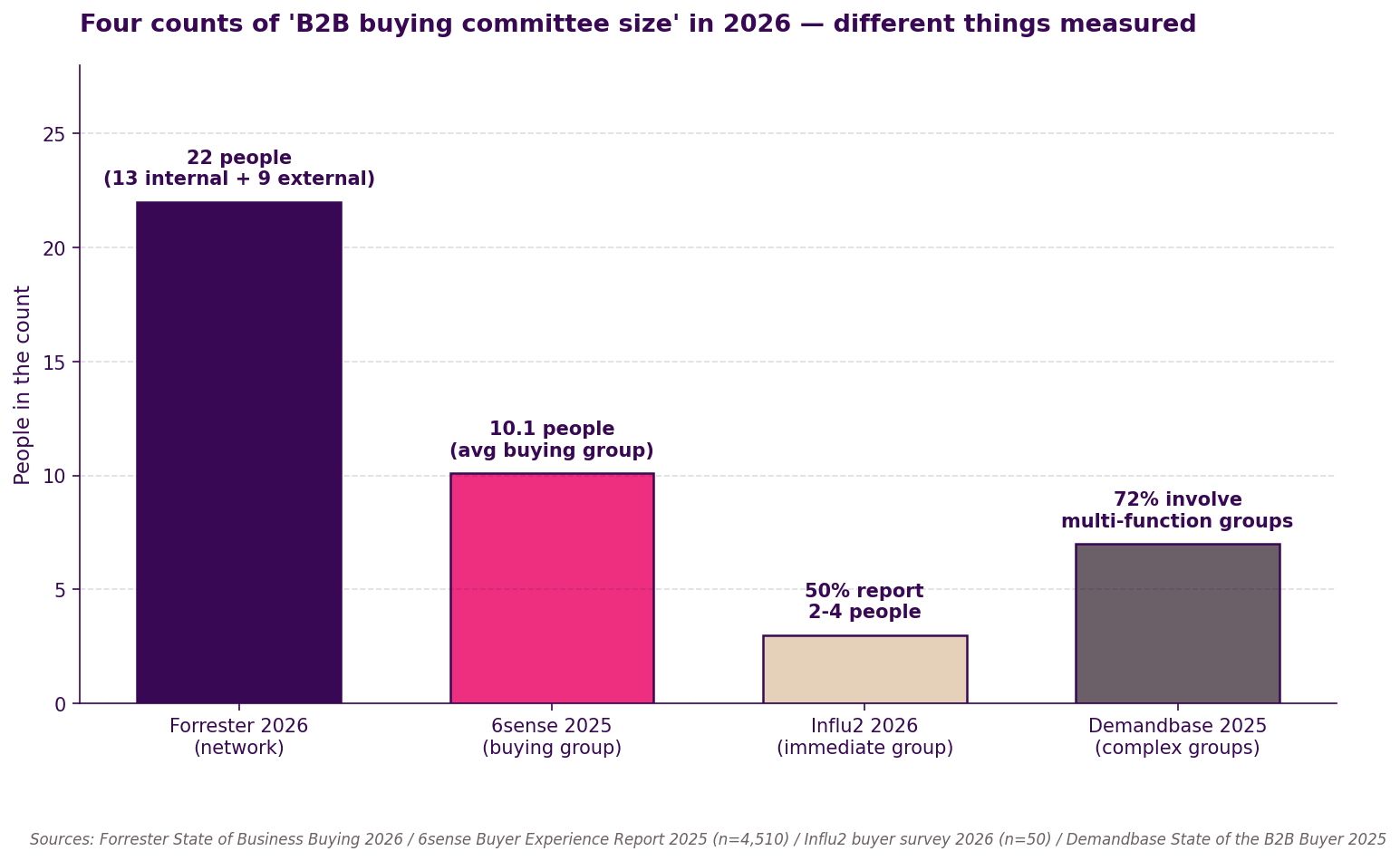
The directional agreement matters more than the headline numbers. All four sources point the same way: groups are larger than they were five years ago, procurement and finance are involved earlier, and end-user influence is shrinking relative to executive and cross-functional input.
Forrester 2026 reports procurement decision-makers in 53% of cycles. The same release notes that 94% of buyers in groups of six or more report clear benefits from the larger committee - the size is a feature, not a bug. Influ2 finds end users carry decision-making weight for only 16% of buyers, which means winning the user does not win the deal. TrustRadius's 2025 Bridging the Trust Gap report finds VP- or C-level involvement in 66% of purchases.
The single takeaway in plain language: pick the number that fits your sales motion. To measure people you have to meet with, use 10. To measure people you have to win over, use 22. For an SMB-only motion, use 2-4. The reconciliation is the working knowledge the post is built around. For deeper coverage of how to map and engage these groups, see the buying-committee primer and the multithreading playbook.
The shortlist forms before sales gets the lead
By the time sales sees a lead, the deal is mostly decided.
6sense's 2025 Buyer Experience Report found that 95% of B2B purchases come from the Day-One shortlist - the list of vendors a buying group has when it begins formal evaluation. The #1 ranked vendor on that shortlist wins about 80% of the time. Ninety-four percent of buying groups rank their shortlist in order of preference before contacting sales.
The earlier-stage data corroborates the same pattern from a different angle. 6sense's 2024 report found buyers were well into their purchasing process before engaging a seller, most already had a preferred vendor at first contact, and most had largely established their purchase requirements before reaching out. Most buyers initiate first contact themselves. Forrester's 2024 State of Business Buying found that most buyers start their journey with at least one vendor already in mind.
The CMO segment data lines up. Wynter's January 2026 survey found that 80% of CMOs arrive at sales calls at least moderately familiar with the vendor, and 48% arrive "very familiar" with deep prior research - up from 22% in the same survey a year earlier. Twelve percent arrive with minimal familiarity. Eight percent only take calls with vendors they already know well.
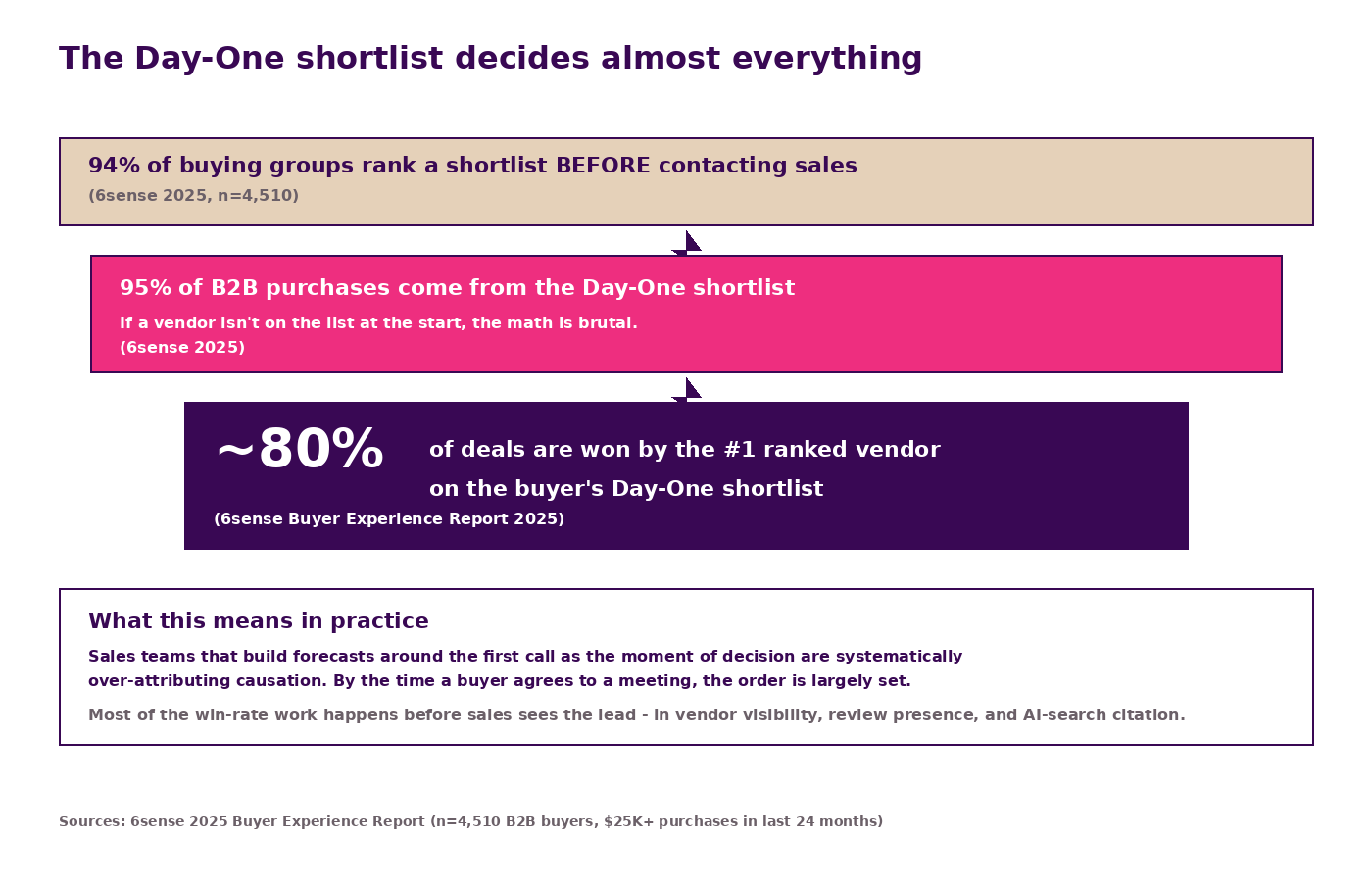
The vendor-evaluation arithmetic is also tightening. 6sense 2025 reports 5.1 vendors evaluated in the typical purchase, up from 4.5 in 2024. Seventy-six percent of shortlisted vendors are already known to the buyer. The winning vendor sees 16 interactions per buyer, essentially flat across the past three reports.
The compression isn't uniform globally. 6sense 2025 reports that EMEA buyers now make first contact at roughly 60% of their journey - earlier than the historical 70% benchmark. Forty-four percent of EMEA buyers say they engage vendors earlier specifically to validate AI claims. The shortening is most visible where AI-driven vendor selection is moving fastest.
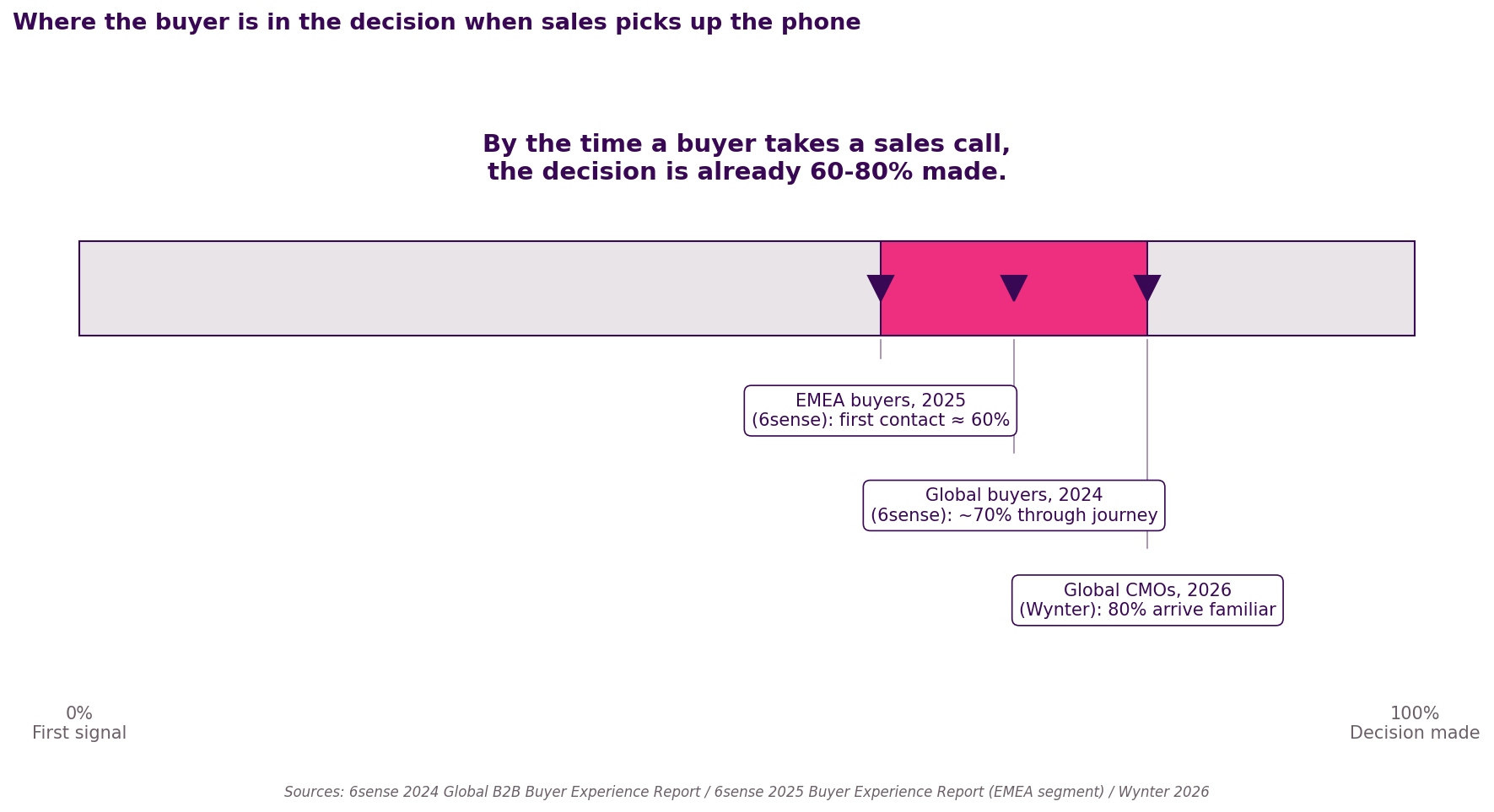
The implication is uncomfortable but consistent across every primary source: most of the decision happens before sales picks up the phone. Sales teams that build their forecast assumptions around the first call as the moment of decision are systematically over-attributing causation. For the broader question of where intent signals show up in this compressed journey - and which stage most vendors are still ignoring - the buyer intent funnel is the corresponding spoke. For the share of decisions that involve switching from an existing vendor, the switching guide playbook covers the content side.
Trials are the new demo
The risk-reduction tool of choice in 2026 is the trial, not the demo.
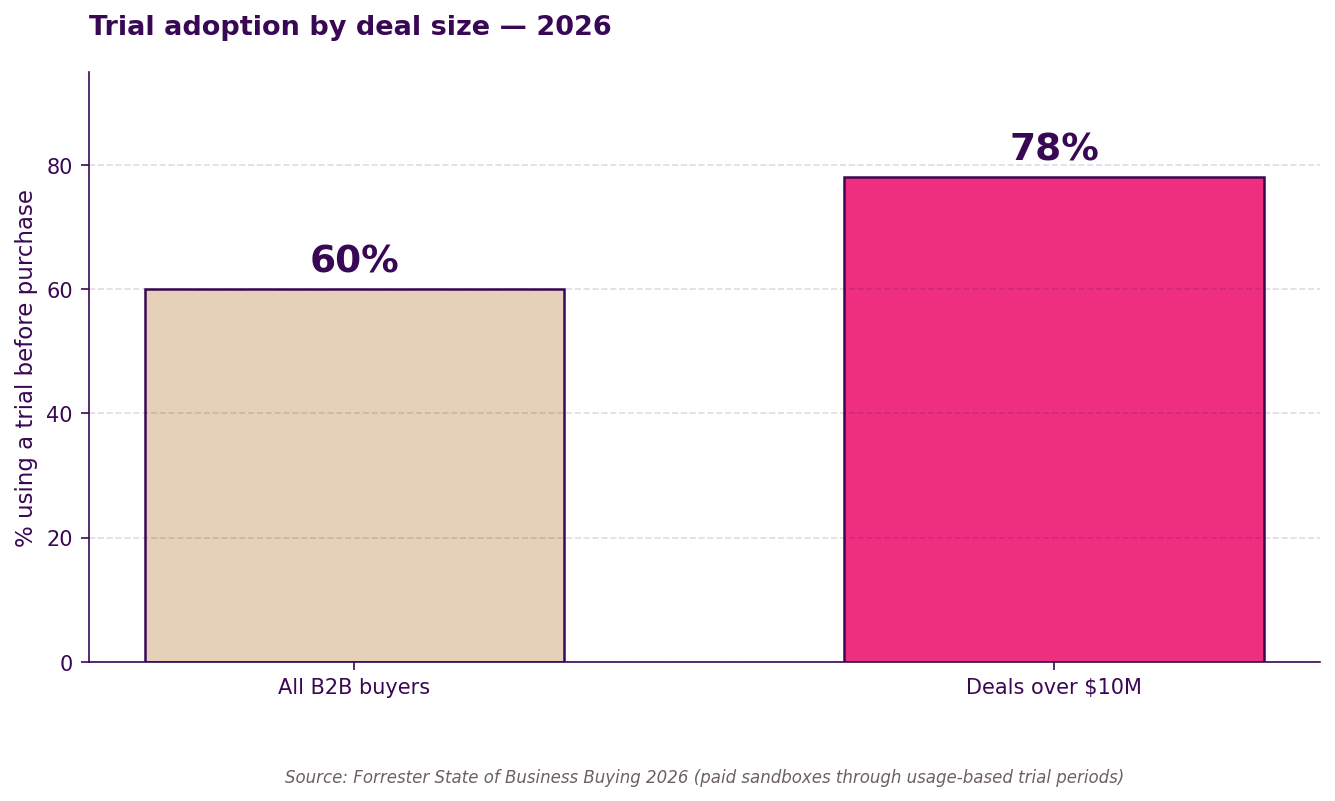
Forrester's State of Business Buying 2026 found that more than 60% of business buyers now use a trial before purchasing - paid sandboxes, usage-based trial periods, or bespoke proofs of concept. For purchases over $10 million, trial adoption climbs to 78%. Forrester VP and Principal Analyst Barbara Winters frames the shift as a response to investment-justification pressure: B2B buyers are "under immense pressure to justify investments and minimize risk."
Gartner's March 2026 press coverage confirms the directional shift toward self-driven evaluation. Two-thirds of B2B buyers prefer rep-free purchasing. Buyers who reach what Gartner calls "value clarity" - clear understanding of how a product improves their specific outcomes - are 2x more likely to report a high-quality purchase. The corresponding Gartner 2025 sales survey press release put the rep-free preference number at 61%; the 2026 number is roughly 67%, suggesting the trend is still climbing year-over-year.
McKinsey's 2024 B2B Pulse Survey (n=3,942 across 13 countries) found that the average B2B buyer now uses more than 10 interaction channels, up from 5 in 2016. The "rule of thirds" - roughly equal split of buyer interaction time across traditional, remote, and self-serve - holds across industries and geographies. Thirty-nine percent of B2B buyers say they are willing to spend $500,000 or more per order through self-serve digital commerce or remote contact. Seventy-one percent of B2B sellers offer some form of e-commerce; 34% of revenue at those companies now comes through it.
What this means in practice is that trials sit between product-led growth and traditional sales-led motions. The dominant pattern is bespoke or usage-based trial periods orchestrated by sales but driven by the buyer's own evaluation. "Rep-free" doesn't mean rep-eliminated. Buyers still want human contact at specific decision junctures - security review, contract negotiation, AI-claim verification - and the EMEA data on vendor engagement specifically for AI clarity confirms this.
The post-purchase reality - regret, retention, and what the public review layer captures
The numbers on buyer's remorse haven't improved.
Forrester's 2024 State of Business Buying found that 86% of B2B purchases stall during the buying process and 81% of buyers end up dissatisfied with the provider they ultimately choose. The pattern persisted into the 2026 update. Gartner Digital Markets' research on why software buyers experience regret is no longer independently checkable - the property was sold to G2 in February 2026, and the only surviving capture of that analysis does not preserve the underlying figures.
The trust-gap data is sharper. TrustRadius's 2025 Bridging the Trust Gap report found that 54% of buyers had a conversation with an existing user before purchasing - while vendors believed only 38% of buyers had done so. That 16-point gap is the gap between the buyer's reality and the seller's mental model. Only 23% of buyers spoke with a vendor-supplied reference; the rest of those user conversations happened in private peer networks - LinkedIn DMs, Slack communities, Reddit threads, alumni groups, customer-only forums. The reference call most vendors think they're winning isn't the reference conversation that actually shapes the decision. The same TrustRadius work found 66% of purchases involved VP- or C-level participation; the implication is that the trust-gap is showing up at the level of the buyer with the most influence.
The fake-review layer adds a second dimension. TrustRadius's 2024 Buying Disconnect reports that 73% of tech buyers see fake reviews on review sites regularly or sometimes. The integrity of public reviews is itself now a buyer concern - and the G2 + Capterra + Software Advice + GetApp consolidation into a single network reaching 200M+ buyers and roughly 6M verified reviews concentrates that integrity question into one operator.
6sense 2025 sits underneath all of this with a connecting data point: AI features are involved in 89% of B2B purchases. AI claims are often vague, not yet fully proven, or harder for buyers to evaluate against a familiar baseline. The combination of high AI-feature inclusion and high regret rates compounds the problem.
This is the category where reviews stop being a discovery channel and become a switching signal. Buyer's remorse becomes public when a frustrated customer writes a critical review of the incumbent - timestamped, attributable, category-specific. The methodology that turns those signals into outreach has a name: Frustration-Led Growth. Coverage of that methodology lives elsewhere on this site; the data point worth carrying forward here is that the public review layer captures this signal in a way no anonymous web-traffic feed ever could.
The integrity of the review layer matters more in 2026 than it did in 2024. With one operator now stewarding the dominant network, the review layer is both more comprehensive and more singular - and the buyer concerns about authenticity are now a centralized risk rather than a distributed one.
What changed since 2025 - and what to expect through end of 2026
Five trajectories carry from the 2025 baseline into the rest of 2026.
AI-mediated discovery is still pre-saturation. Wynter's 0% / 24% / 84% trajectory across 2024-2026 plus G2's directional growth (60% to 71% chatbot reliance; 36% to 53% productivity preference) both still point up and to the right. CMOs are running ahead at 3.5x year-over-year, a pace that has to slow once adoption nears universal, but the broader buyer base has plenty of headroom left.
Review-layer consolidation is fresh. G2 closed the Capterra / Software Advice / GetApp acquisition on February 5, 2026. Product implications - a single discovery taxonomy, an Answer Engine Optimization-aligned data layer, and what G2's own framing describes as "3x more buyer intent signals" - are still rolling out. A first integrated buyer-behavior report from the consolidated network is likely in the Q3-Q4 2026 window. This page will be refreshed when it lands.
Committee size keeps drifting up. All four primary sources cited in this report agree on the direction. Procurement and security continue moving earlier in the cycle. Demandbase's 72% high-complexity figure and Forrester's 53% procurement involvement reinforce each other.
Reps are being recast as validators, not discoverers. Forrester frames it directly: "AI search tools offer speed and efficiency, but often deliver incomplete or unreliable information, creating mistrust. Buyers compensate for this by seeking validation from trusted sources." Selling motions that survive the next twelve months are the ones that move reps off category education and onto AI-claim verification, security walkthroughs, and integration confirmation.
Trial-as-default keeps climbing. Forrester's 60% / 78% trial adoption is moving up across every deal-size band. Trial expectations are on track to harden into procurement requirements through 2026 as buyers calibrate against the post-purchase regret data.
What this report does not predict: AI agents replacing sales reps, PLG eating sales-led entirely, or a single-vendor consolidation of the buyer-intent category. The data does not support any of those claims, and either would dilute the credibility of the rest of the page.