
Demand Generation vs Lead Generation and Why Your SaaS Needs Both
In B2B SaaS, the demand gen vs lead gen argument is mostly semantic. The strategic gap shows up in pipeline reviews. Here's the difference, and why you need both.

Marketing teams have argued about this for two decades. The literal difference is small. The strategic difference shows up every time a B2B SaaS CFO asks where the pipeline came from.
What is demand generation?
Demand generation is the marketing work that creates awareness and preference for your product across people who could buy it. Most of them aren't buying yet, and that's the point.
The channels are familiar: thought leadership content, podcasts, organic social, brand campaigns, SEO, events, communities, paid awareness ads. None of them capture contact info directly; their job is to build familiarity.
Why bother marketing to people who aren't buying? Because in a given quarter, only about 5% of your target market is in-market. That's the 95-5 rule from Professor John Dawes at the Ehrenberg-Bass Institute, popularized by the LinkedIn B2B Institute. The other 95% will be in-market later. If your brand isn't familiar to them by then, you're starting from zero.
Demand gen is hard to measure cleanly. You're tracking branded search, share of voice, organic and direct traffic, podcast listens, content engagement. None of it maps to a single deal. That's the nature of building familiarity in a category where the buyer persona you care about may not buy for another nine months.
What is lead generation?
Lead generation is the work of capturing identifiable interest from people who've raised their hand and qualifying whether that interest is real.
Where demand gen fills the room, lead gen collects names from the people in it. Common tactics: gated content, webinars with registration, demo request CTAs, paid search lead forms, free trial signups, account-based motions, and retargeting that ends in a form fill.
Lead gen is measurable in a way demand gen isn't. Form fills, MQLs, SQLs, opportunities sourced, cost per lead, MQL-to-SQL conversion rate. Every step is countable, which is why CFOs love it and why teams default to it under budget pressure.
What separates lead gen from list-buying is the qualification step. A framework like BANT or a fit-and-intent score decides which captured names go to sales and which go back into nurture.
Demand generation vs lead generation: what's actually different?
The cleanest way to see the difference is side by side.
| Demand generation | Lead generation | |
|---|---|---|
| Goal | Awareness, preference, recall | Captured, identifiable interest |
| Time horizon | Months to quarters | Days to weeks |
| Output | Pipeline influence (hard to attribute) | MQLs and SQLs (easy to count) |
| Typical owner | Demand gen, brand, content team | Growth team in partnership with SDRs |
| Core metrics | Branded search, share of voice, organic and direct traffic, content engagement | Form fills, MQLs, SQLs, cost per lead, MQL-to-SQL conversion rate |
| Channel examples | Podcasts, SEO, organic social, events, thought leadership content | Gated reports, demo CTAs, webinars, paid search lead forms |
| Buyer state | Doesn't know they have a problem yet, or doesn't know you exist | Knows they have a problem and is considering options |
The "vs" framing is misleading. Demand gen creates the conditions for lead gen to work. Lead gen captures what demand gen warmed up. They run in sequence, not in opposition.
Why do most B2B SaaS teams need both?
"Do I need both?" is the second-most-common reason people search this term. The answer for B2B SaaS is yes, and the data backs it up.
Recent B2B buyer research finds that 69% of the B2B purchase process is complete before buyers engage with sellers, and 81% of buyers choose a preferred vendor before they ever talk to sales. That research happens in the dark funnel: private Slack groups, Reddit threads, peer DMs, review platforms.
If you only run lead gen, you're paying to capture people who never knew you existed and never built a preference. They show up to your form because of a paid search click. They convert at a low rate because they're shopping cold.
If you only run demand gen, you have a brand that buyers recognize and a pipeline number that flatlines. Marketing leadership turns over.
A sharp ICP helps both motions. Demand gen targets the right ears with the right messages; lead gen filters the right names from the captured list. Without ICP clarity, both motions burn budget.
Where do B2B SaaS teams get the mix wrong?
Three failure modes show up over and over.
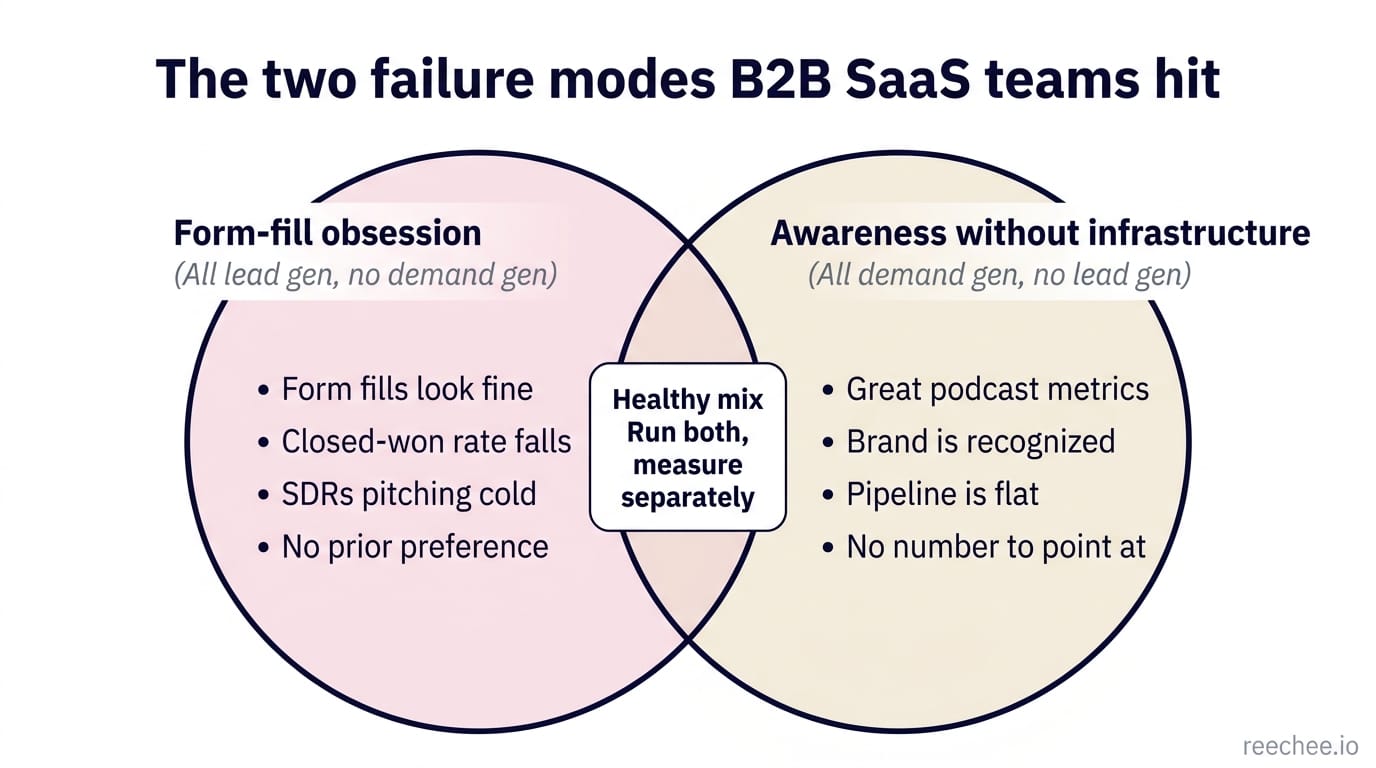
Form-fill obsession
All lead gen, no demand gen. The form fill numbers look fine for a few quarters. The closed-won rate quietly falls because the people filling forms have no prior preference for you, and SDRs are pitching cold every time.
Awareness without infrastructure
All demand gen, no lead gen. The podcast metrics are great, the brand is recognizable, the pipeline is flat. Marketing finds itself defending budget at the next QBR with awareness slides and no number to point at.
Confusing the two
Measuring demand gen on MQLs (it'll fail) or measuring lead gen on share of voice (it'll fail). The motions need different metrics because they're answering different questions. A podcast won't fill a form this quarter. A demo CTA won't build category preference. Holding either motion to the wrong scoreboard kills the thing that's working.
The fix is structural: separate the metrics. Define success for each motion on its own terms.
How is this changing in B2B SaaS in 2026?
Form fills are no longer the only signal of buying intent, and for many B2B SaaS deals they're not even the primary one. Buyers research in private (Slack groups, Reddit, peer DMs, review platforms) and often skip the MQL stage entirely.
G2's own buyer research puts public review sites at the top of the list of consulted information sources, ahead of vendor websites and analyst reports. The buyers who matter most aren't filling forms. They're reading reviews and posting their own.
A third motion is emerging in B2B SaaS: signal-based selling. Catch the buying signal before it becomes a form fill. Useful signals include hiring patterns, tech stack changes, leadership moves, and (most underused) public frustration with current vendors on review platforms like G2 and Capterra. When a competitor's customer posts a critical review, that's articulated buying intent with a name attached. Most teams miss it.
This is different from traditional buyer intent data, which scores anonymous web traffic and account-level surges. Pre-intent is a real person describing a real frustration with the product they're already using. We call this approach Frustration-Led Growth, a third capture motion alongside demand gen and lead gen.
One way to act on this: Reechee monitors review platforms and surfaces Opportunity Alerts when a competitor's customer reports a frustration, with the company, contact, and pain context attached. It's one approach among several; the broader point is that B2B SaaS teams in 2026 are no longer choosing between demand gen and lead gen alone.
The takeaway for B2B SaaS leaders
Demand gen builds the room. Lead gen captures the people in it. Both need their own metrics, and both break without a sharp ICP.
The shift in 2026 is that form fills are no longer the only capture point worth measuring. The teams winning right now run demand gen and lead gen in parallel, hold each motion to its own scoreboard, and add signal-based selling: real buying intent picked up before it surfaces as an MQL.
If you're all-in on one motion, audit your funnel for the failure modes above and fix the one hurting you most.